

Large-scale Battery Storage System M5BAT – Live View
Grid Frequency
AC Power at Grid
Connection Point
Modular research-oriented battery storage system with 5 MW / 5 MWh with currently 6 active battery Units
Current grid frequency of the continental european grid measured at M5BAT
Current AC Power output of the battery storage M5BAT
Project M5BAT
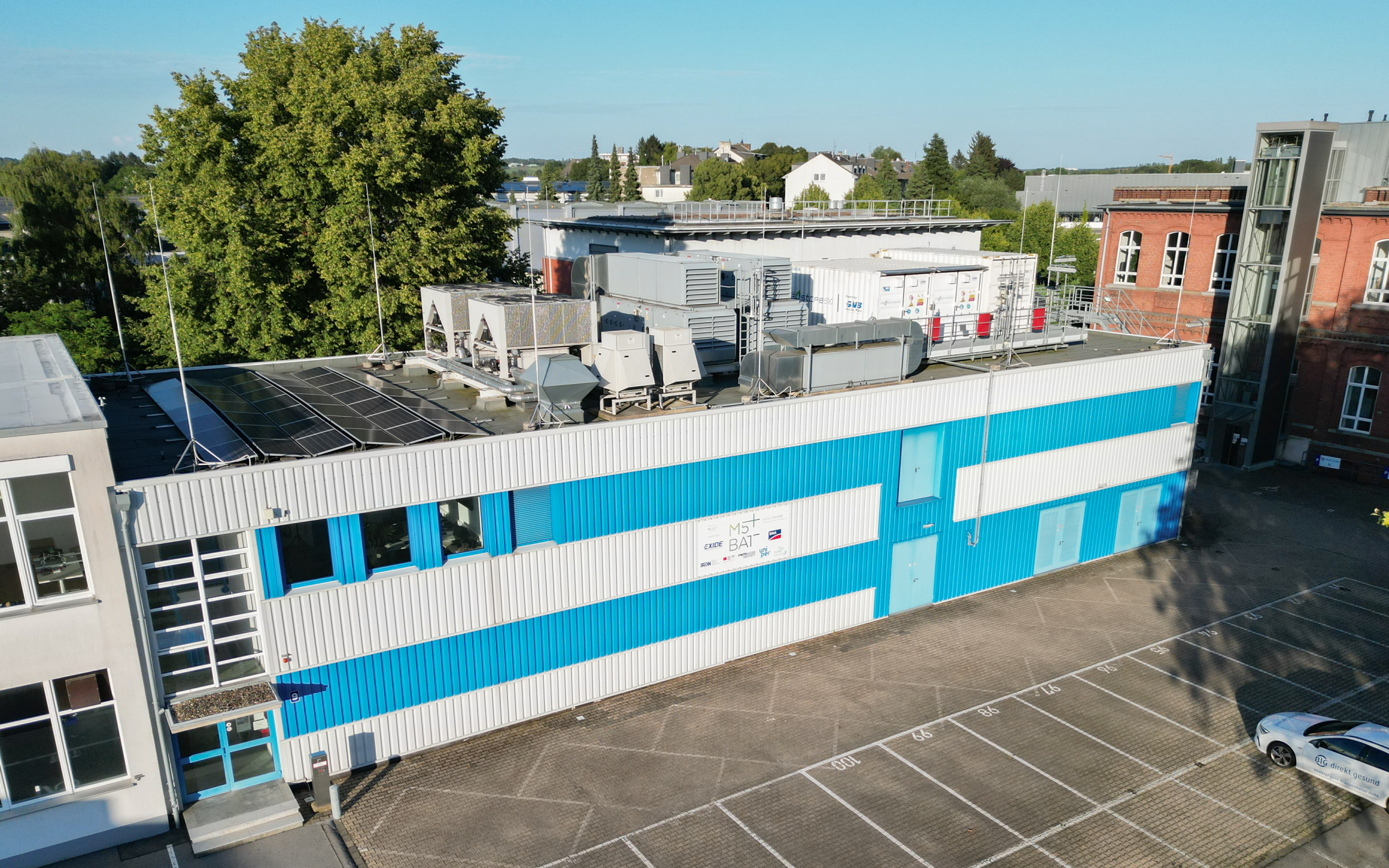
The Institute of Power Electronics and Electrical Drives (ISEA) in Aachen operates the M5BAT (Modular Multi-Megawatt Multi-Technology Medium-Voltage Battery Storage) large-scale battery storage system with a power capacity of approx. 5 MW.
In the M5BAT 4.0 project phase, continuous system operation in the frequency containment reserve market and intraday trading will be replaced by cross-market optimization and the battery storage system will be upgraded. In future, further technologies will be researched and compared with each other in terms of battery aging and performance.
Data Analysis
ISEA’s M5BAT battery storage system collects data through continuous operation and marketing on the German market. From the data, some analyses on the following topics are shown:
- Large-scale battery storage systems in Germany
- Battery Storages used for Frequency Containmnet Reserve
- Efficiency on pack level
- Energy throughput and battery cycling
Further information and evaluations can be found on the M5BAT battery storage system project page: m5bat.isea.rwth-aachen.de
Research
Research results on various topics relating to large-scale battery storage systems using the example of M5BAT
- Aging of batteries in large-scale storage systems
- Performance tests
- Energy management system & power distribution in modular battery storage systems
- Data analyses
Large-Scale Battery Storage Systems
- Control reserve (frequency containment reserve and increasingly automatic restauration reserve)
- Arbitrage trading on the electricity exchange
- Integration of large PV and wind farms
- Grid booster for grid operation management
- Optimization of energy management at large industrial sites
Grid Frequency
The grid frequency is identical throughout the entire continental European interconnected grid (ENTSO-E) and serves as an important parameter for the current status and stability of the electricity grid. The target frequency in continental Europe is set at 50Hz. As it is not possible to store electricity directly in the grid, supply and demand in the grid must be balanced. If the frequency falls, this means that the demand for electricity is greater than the power currently being fed into the grid. If the frequency rises, there is too much electrical power in the grid. Smaller frequency fluctuations around 50Hz are balanced out by control reserve products such as frequency containment reserve. Larger frequency fluctuations are compensated for by other control products such as automatic frequency restauration reserve. The graph shows the measured grid frequency over the last 30 minutes. Stronger frequency deviations can be observed around full hours in particular. If you are further interested in the topic of grid frequency and the European electricity grid, a detailed analysis of the grid frequency is available here: 10.1016/j.egyr.2024.12.057
FCR-Specific Energy Throughput and Battery Cycling
An EPR of at least 0.81h is required for the frequency containment reserve (FCR) in Germany. The graph shows the energy throughput for pure FCR operation from 2018 to 2024. With an EPR of 1h, this results in approx. 300 EFC per year with a slight variation depending on the year in focus. With a different storage design, the EFC changes accordingly. Consequently, higher EPR designs result in lower cyclization of the batteries.
Note: this graph does not take into account the necessary recharging management.
Energy Throughput
The cumulative amount of energy for the respective service provided is shown here on a daily and monthly basis. A distinction is made between charging and discharging. Since battery energy storage systems also incur losses (transformers, converters/inverters, and battery packs), the amount of energy charged is always greater than the amount of energy discharged. The following services are shown:
- frequency containment reserve (FCR)
- automatic frequency restauration reserve (aFRR)
- Redispatch
- Wholesale
The services shown can be superimposed during operation so that the sums of the energy quantities shown for each service/product do not correspond to the physical energy throughput of the battery storage system at the grid connection point.
Battery Efficiency on Pack-Level
The Battery efficiency describes how much of the energy stored in a battery can be used again when it is discharged. At the battery pack level, not only the cell efficiency is considered, but also the losses that occur in the connecting cables, the battery management system (BMS), the balancing and the cooling systems. For M5BAT, the cooling system is not part of the efficiency determination.
The graph can be used to estimate the efficiency at battery pack level. The energy throughput per battery unit per month is considered here. An error can be entered in the value due to a difference in the state of charge at the beginning and end of the month. This becomes smaller as the energy throughput increases. Efficiency values in the range of 90 to 95% are shown for all lithium-based battery units.
Battery Cycles – Daily
For batteries, the number of cycles completed is an important parameter for assessing service life and performance. Each battery can only run through a limited number of cycles until the end of its service life. Capacity and performance decrease continuously. Depending on the cell chemistry, the batteries have different cycle resistance and age at different rates depending on the cycle depth, temperature and current load. The graph shows the daily equivalent full cycles (EFC) of the M5BAT battery storage system. It can be seen here that the LTO battery unit cycles more, as this is a more cycle-stable technology. Depending on the operating mode and load, there are different equivalent full cycles per day.
M5BAT Team

Lucas Koltermann
Dr.-Ing. / Head of Department
Head of Department with focus on large-scale battery storage systems at the Chair of Electrochemical Energy Conversion and Storage System Analysis

Daniel Dang
M. Sc. / Scientist
Software developer and scientist at the Chair of Electrochemical Energy Conversion and Storage System Analysis

Niklas Demel
M. Sc. / Scientist
Scientist specializing in the operation and data analysis of large battery storage systems at the Chair of Electrochemical Energy Conversion and Storage System Analysis

Mauricio Celi Cortés
M. Sc. / Project leader
Scientist specializing in modeling and simulation of large battery storage systems at the Chair of Electrochemical Energy Conversion and Storage System Analysis
Dirk Uwe Sauer
Prof. Dr. rer. nat. / Director
Professor of Battery and Energy Systems Research and Director of the CARL Research Center