
About FCAs and the Impact on BESS Revenue
Revenue impact across Germany. Under the FCA rules we analysed, a 2 h BESS would have lost between 24 % and 47 % of its revenue in 2025, and 31 % on average.
FCA design. The contract alone can change the loss by up to 16 percentage points at the same location. About 20 percentage points are the same in every FCA we analysed and come mostly from the limit on aFRR, which is currently the largest revenue stream of a BESS in our revenue modelling. The rest depends on the renewable coupling, and above all on whether it leaves the BESS a window without limits.
Location. Under the same rules, the location makes a difference of about 12 percentage points. The more time without limits, the lower the loss, and strong wind costs more than weak sun, because it limits feed-in, which is twice as expensive as limited charging. Coastal sites lose the most, sites in the Rhineland and the Ruhr area the least.
Find the revenue loss for every district in an interactive map here.
What are FCAs?
A flexible connection agreement (FCA) offers a battery energy storage system (BESS) a faster route to the grid. In return, the grid operator sets rules for how the BESS may be operated once it is connected. Over the past year more and more distribution grid operators have published such rules, and E.ON has announced a common template for its grid companies that goes back to the pilot project of ECO STOR and SH Netz in Bollingstedt [1, 2]. The storage association BVES supports flexible connections in principle, but warns against a rigid standard contract “from Flensburg to Garmisch-Partenkirchen” and asks for rules that only restrict what the local grid really needs [3]. With this post we want to add numbers to that debate: what does an FCA cost a BESS, and how much of that cost depends on the contract and how much on the location?
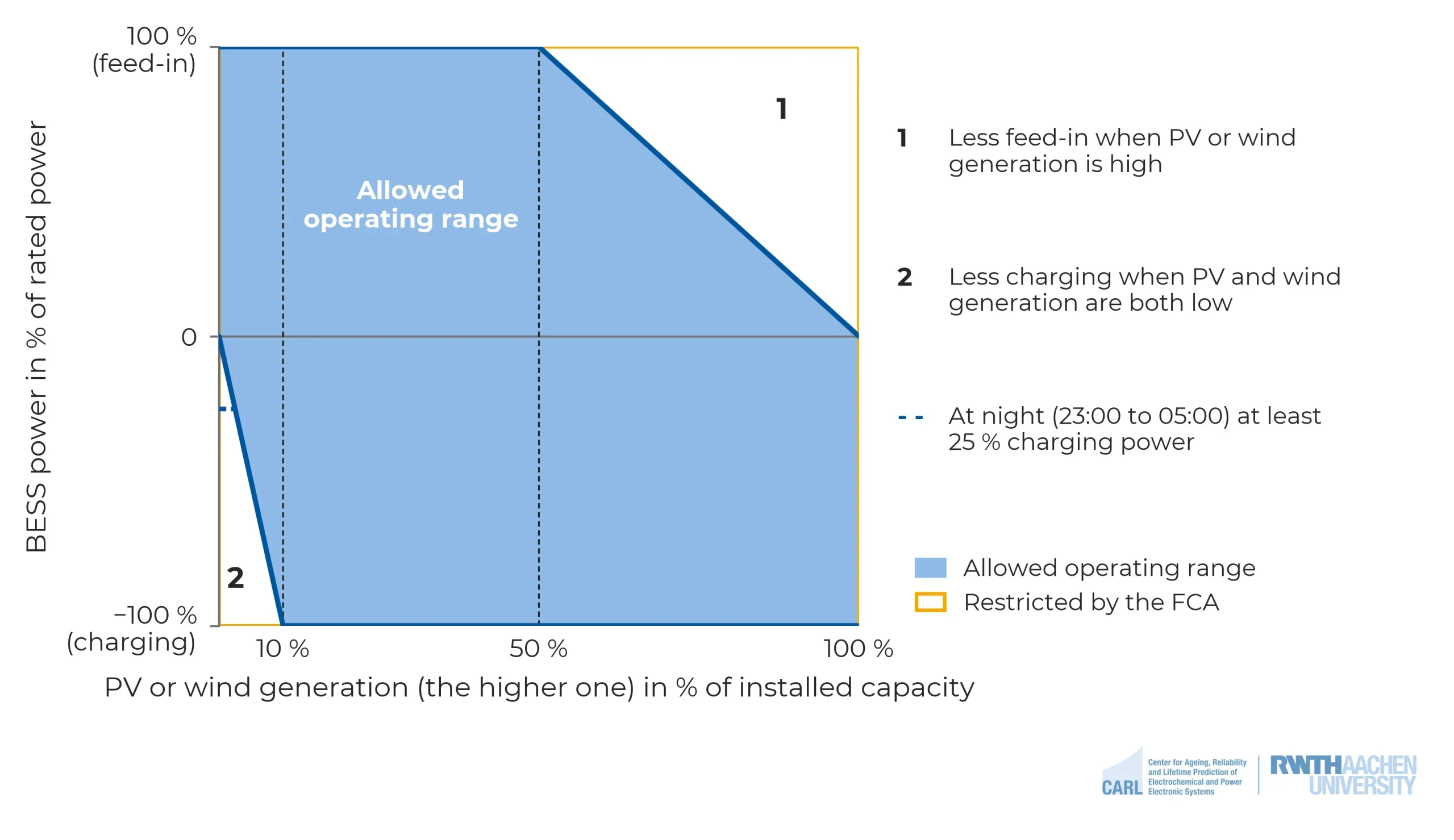
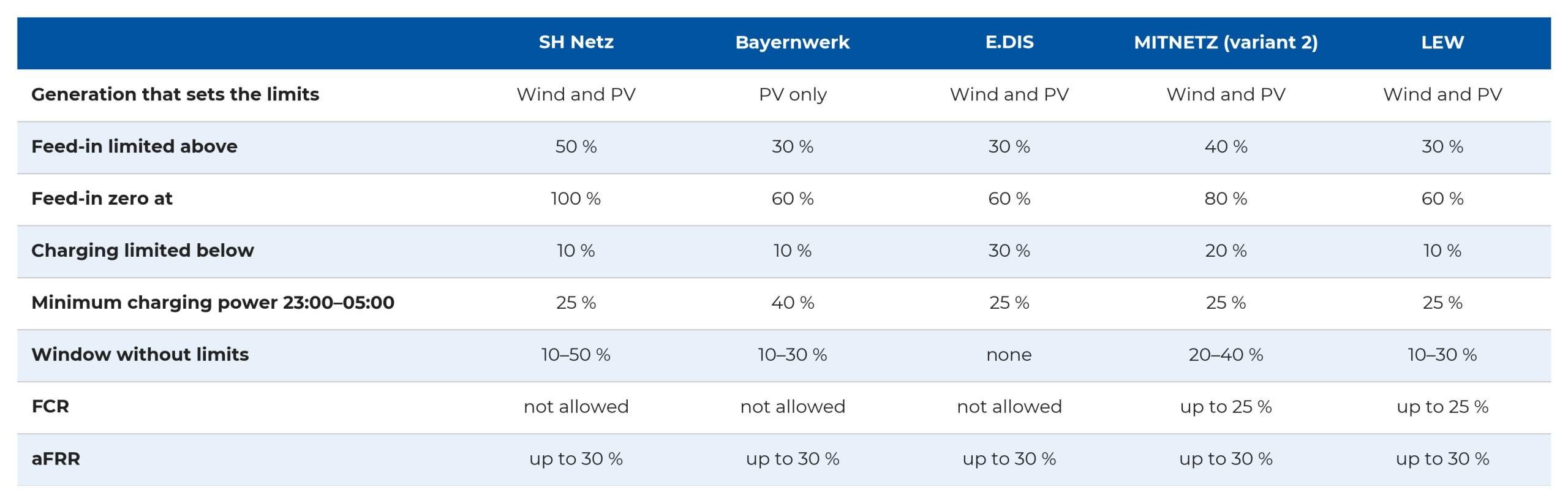
We looked at the published FCAs of five grid operators: SH Netz, Bayernwerk, E.DIS, MITNETZ and LEW [2, 4–7]. They all follow the same template. aFRR is limited to 30 % of the rated power, FCR is either excluded or capped at 25 %, and the BESS may change its power by no more than 6 % per minute. The central element, and the one where the contracts differ, is the coupling to local renewable generation: when local wind or PV generation is high, the BESS may feed in less, and when both are low, it may charge less (Figure 1). Between the two limits lies a window in which the BESS can use its full power in both directions. Table 1 shows how differently the five grid operators set these limits.
Which rules apply where
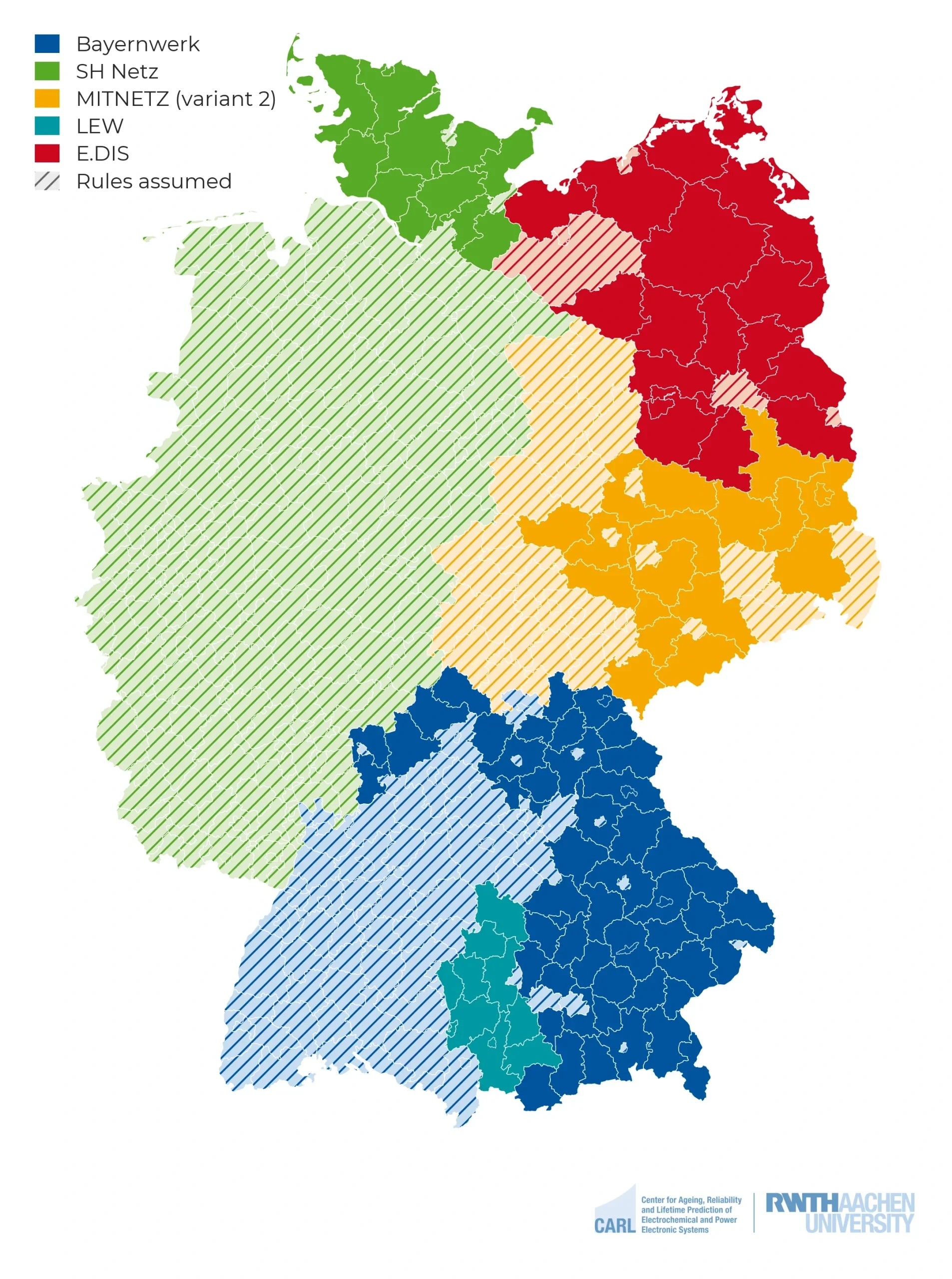
As not every DSO in Germany has yet published its own FCA we assigned public FCA rules to these districts. Using the Marktstammdatenregister (MaStR), we assigned every German district to the grid operator to which most of its wind and PV capacity at medium and high voltage is connected. 108 of the 400 districts belong to one of the five grid operators above. For the remaining districts no FCA has been published yet, so we assumed one backup rule set per federal state: the rule set that already covers most districts in that state, or, where no district in the state has published rules, a rule set we chose. Baden-Württemberg gets the Bayernwerk rules, Berlin the E.DIS rules, and all other states without published rules the SH Netz rules, which are the most detailed template so far. Figure 2 shows the result, with assumed rules hatched.
How we model the renewable coupling
The FCAs use reference curves that turn local wind speed and solar irradiance into a generation between 0 % and 100 %. Inpractice the BESS operator has to predict the wind speed and sollar irradiance at a specific site close to the BESS location and then use the reference curve to calculate the generation share. We follow this approach: for every district we take the most central wind turbine and the most central PV plant from the MaStR, use quarter-hourly weather data for these two sites, convert it with the reference curves and apply the limits of the respective FCA. The BESS knows these limits a day in advance and plans its trading within them.
In general this approach in the FCA design fails to reflect the real renewable power generation at the site because the reference power curves overestimate power delivery most of the time. This leads to more BESS restriction than would really be necessary. For sure, DSO use this a s a safety margin in this young stage of the discussion but this would definetely be a lever for future policy adjustments.
How the revenue impact varies across Germany
We simulated a 2 h BESS with 2 cycles per day in every district for 2025, once with and once without the local FCA, trading cross-market in FCR, aFRR and the intraday continuous market. Without an FCA, the BESS could have earned about 242,000 €/MW/a. With the FCA, it loses between 24 % and 47 % of that revenue, and 31 % on average (Figure 3). Both ends of this range, Neuwied and the city of Rostock, are districts with assumed rules; among the districts with published rules the loss ranges from 26 % to 46 %.
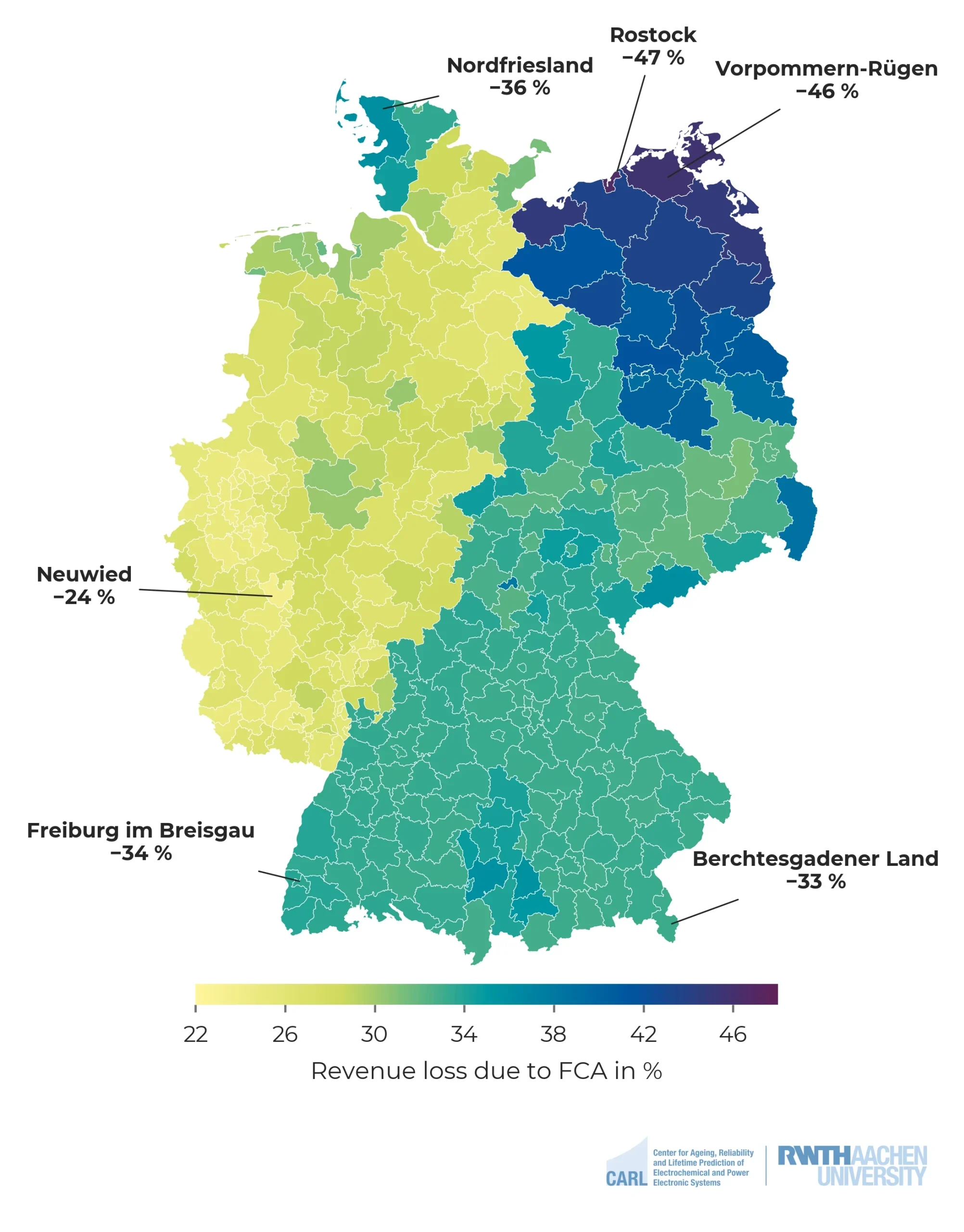
Districts under the SH Netz rules lose 27 % on average, those under the Bayernwerk, MITNETZ and LEW rules around 33 to 35 %, and those under the E.DIS rules 42 %. All ten districts with the highest losses lie in Mecklenburg-Vorpommern and Brandenburg under the E.DIS rules. Within each rule set, however, the losses still vary from district to district. We can see that mainly two factors determine revenue impact: the design of the FCA contract, and the location of the BESS.
How much the FCA design matters
The clearest way to see the effect of the contract is to keep the location fixed and change the rules. In Vorpommern-Rügen, a BESS under the SH Netz rules would have lost 30 % of its revenue in 2025. Under the E.DIS rules that actually apply there, it loses 46 %. The weather is the same in both cases; the difference of 16 percentage points comes from the contract alone.
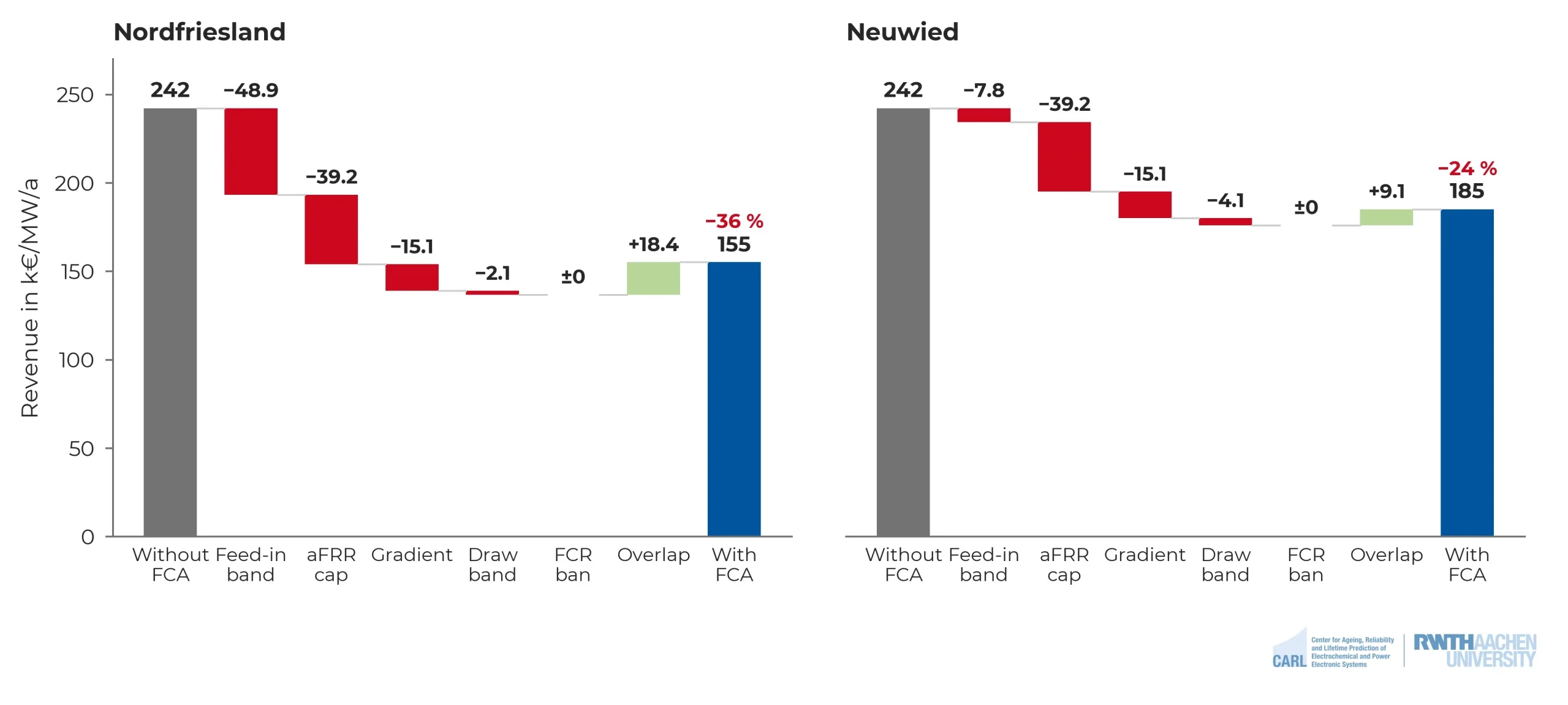
Part of the loss is the same in every FCA we analysed. The 30 % limit on aFRR hits the core of the business case, because aFRR capacity and energy make up more than half of our reference BESS. On its own, the aFRR limit costs about 16 % of the revenue, and together with the ramp rate limit these rules cost around 20 % everywhere (Figure 4). How far grid operators allow BESS to take part in balancing markets is therefore one of the most important levers of any FCA.
Beyond these location-independent rules, the contracts differ in the renewable coupling, and this is where the large differences arise. The decisive setting is the window between the charging and the feed-in limit. Under the SH Netz rules, it spans 40 percentage points of renewable generation, and a BESS in the E.DIS area would be free of any limit in almost half of the year. The E.DIS rules leave no such window at all, so in almost every quarter hour one direction is restricted. The coupling rules also determine how strongly the loss depends on the location.
How the location matters
To isolate the effect of the location, we look only at the 184 districts in which the SH Netz rules apply. Even here the loss ranges from 24 % in Neuwied to 36 % in Nordfriesland. The ten districts with the highest losses lie almost all on the North Sea and Baltic coast, the ten with the lowest in the Rhineland, the Ruhr area and the Eifel.
The first thing that matters is how much time the coupling leaves without any limit. Figure 5 shows this share for every district against its revenue loss. As a rule of thumb, every additional percentage point of time without limits reduces the loss by about 0.4 percentage points, and this alone explains about three quarters of the differences between the districts.
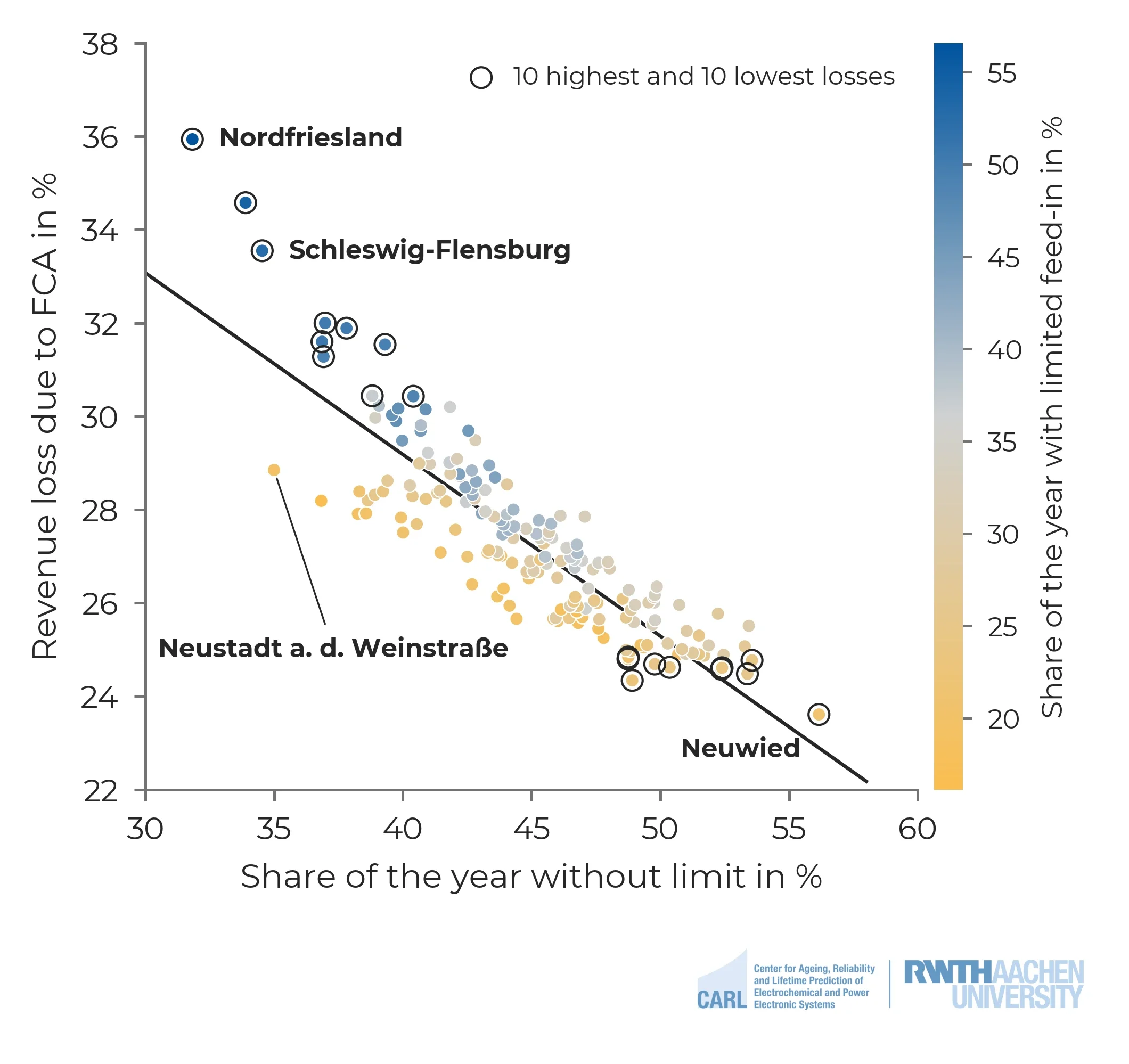
The scatter also shows that not every restricted hour costs the same. Districts that are mostly limited in feed-in (blue) lie above the line, districts that are mostly limited in charging (orange) lie below it. A feed-in limit costs almost twice as much as a charging limit of the same depth, because it blocks positive aFRR and intraday sales at once, while the charging limit is softened by the minimum charging power at night. Feed-in limits come from strong wind, so wind has a much larger impact on the loss than PV, which limits feed-in only around midday and does so in a similar way across the country.
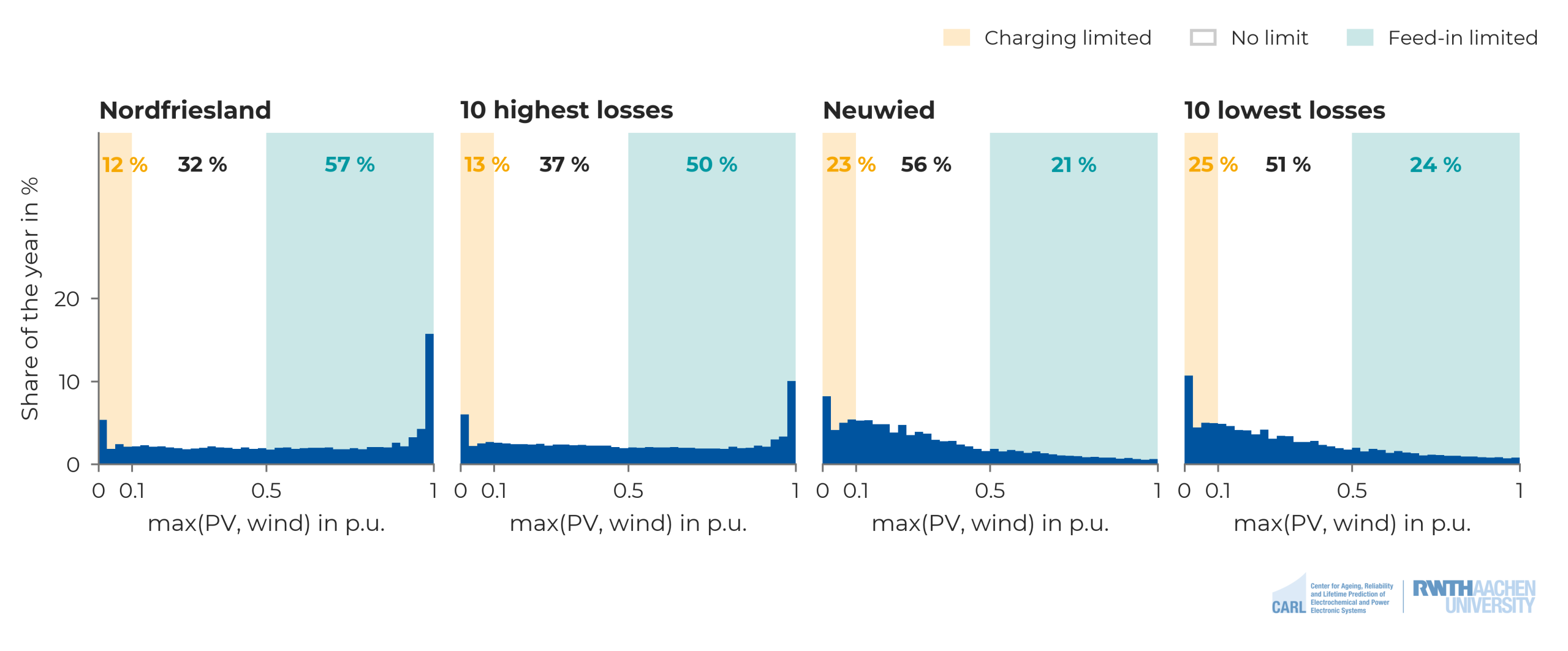
Figure 6 compares the ten districts with the highest and the ten with the lowest losses, together with Nordfriesland and Neuwied as the two ends. In the high-loss group, the renewable generation is above the feed-in limit in half of the year, and in Nordfriesland it often reaches 100 %, where the BESS may hardly feed in at all. In the low-loss group, this is the case in only a quarter of the year. The low-loss districts are limited in charging more often, but these hours are cheaper. In the end, the ten coastal districts lose about 8 percentage points more revenue than the ten districts in the Rhineland and the Ruhr area.
What we take from this
- Revenue impact across Germany. Under the FCA rules we analysed, a 2 h BESS would have lost between 24 % and 47 % of its revenue in 2025, and 31 % on average.
- FCA design. The contract alone can change the loss by up to 16 percentage points at the same location. About 20 percentage points are the same in every FCA we analysed and come mostly from the limit on aFRR, which is currently the largest revenue stream of a BESS in our revenue modelling. The rest depends on the renewable coupling, and above all on whether it leaves the BESS a window without limits.
- Location. Under the same rules, the location makes a difference of about 12 percentage points. The more time without limits, the lower the loss, and strong wind costs more than weak sun, because it limits feed-in, which is twice as expensive as limited charging. Coastal sites lose the most, sites in the Rhineland and the Ruhr area the least.
You can find the revenue loss for every district on https://battery-charts.de/revenue-index.
References
[1] E.ON: E.ON macht Tempo bei Batteriespeicheranschlüssen. Press release, 18 June 2026.
https://www.eon.com/de/ueber-uns/presse/pressemitteilungen/2026/eon-macht-tempo-bei-batteriespeicheranschluessen.html
[2] SH Netz: FCA – Flexible Netzanschlussvereinbarung für Batteriespeicher.
https://www.sh-netz.com/de/energie-einspeisen/fca—flexible-netzanschlussvereinbarung/fca—batteriespeicher.html
[3] BVES: BVES fordert Branchendialog zu FCA: Flexible Netzanschlüsse ja – pauschale Speicherbeschränkungen nein. Press release, 18 June 2026.
https://www.bves.de/wp-content/uploads/2026/06/20260618PM-FCA.pdf
[4] Bayernwerk Netz: Anlage 4 – Vorgaben zum Betrieb des Graustromspeichers; Technische Vorgaben FCA Batteriespeicher in der Mittelspannung. https://www.bayernwerk-netz.de/content/dam/revu-global/bayernwerk-netz/files/fca/mustervertrag-anlage-4-produkt-I-bage.pdf
[5] E.DIS Netz: Netzanschlüsse ab Netzebene 5 (netzneutral), Anlage 4 – Vorgaben zum Betrieb des Graustromspeichers, with reference curves. https://www.e-dis-netz.de/de/energie-anschliessen/gewerbe-und-Industrie/fca/fca-bess-stand-alone.html
[6] MITNETZ STROM: Vorgaben zum Betrieb des Speichers – Stand-Alone-Speicher in Umspannung HS/MS, with table of reference curves.
www.mitnetz-strom.de/stand-alone
[7] LEW Verteilnetz: Technische Vorgaben Batteriespeicher in der MS. https://lew-verteilnetz.euwest01.umbraco.io/media/mhthiq0p/kundeninfo_fca_standalonebess_lvn_ms.pdf